Under contract and on a clock? Call 516-330-3870 Text Email

Inspect This Home Inspections Army Veteran Owned · NY Licensed
Queens · attached and semi-detached

Home inspector in Astoria, NY

Between 2013 and 2026, Lou Rubino inspected 13 homes in Astoria. The neighbourhood's core is 1910s-to-1930s brick — attached rows on twenty-foot lots, semi-detached two- and three-family houses with shared driveways and rear garages — and inspecting one is city work: flat roofs, parapets, party walls and a century of owners.

Rated 5.0 on Google as of August 2026 · U.S. Army veteran owned · NY licence #16000039568 · 516-330-3870

An Astoria house is inspected from the roof down

On a flat-roofed row house the roof is a floor you never walk and a system you cannot see from the street. Membrane, parapets, skylights and drainage all age in private, and the top-floor ceilings report the results afterwards. Lou gets up there where access allows — and where it does not, New York's rules require the report to say what was not observed and why.

The lot matters too. With most of an Astoria yard paved, every leader and drain has one job — move water away from the foundation — and decades of re-piped, re-routed drainage is where basements get their histories. A two- or three-family adds its own layer: separate systems, separate meters, and alterations made unit by unit.

Related: Buying a Queens co-op instead? · What an inspection costs · Schedule an inspection.
What the inspection can examine here

  • The flat roof, walked where access allows — membrane, parapets, skylights and drainage age out of sight.
  • Top-floor ceilings and skylight wells — where the roof reports first.
  • Rear-yard drainage on paved lots — every leader has one job, and the basement records whether it does it.
  • In two- and three-family houses: each unit's systems, separately — which is why the estimate follows the building.

Photographs from Astoria reports

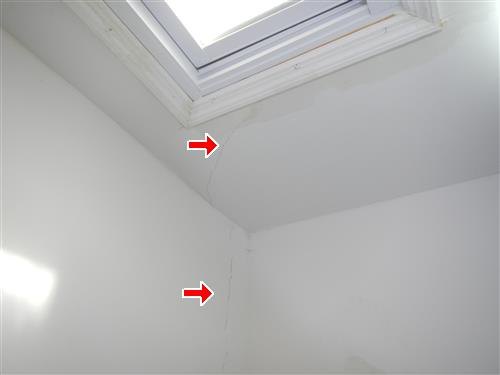
A skylight well in a sloped ceiling with a crack marked by red arrows where it runs into the wall.
Red arrows trace a crack running from the skylight well into the stairwell wall below. The report recommends evaluation and repair by a licensed drywall contractor.
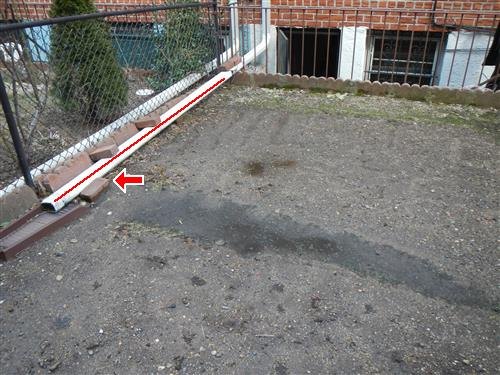
A rear yard with a downspout extension running along the fence line, marked with a red arrow.
A red arrow marks a roof leader discharging into the rear yard along the fence line. The report notes the ground is very muddy and not draining well, and recommends installing a dry well to take the roof water.
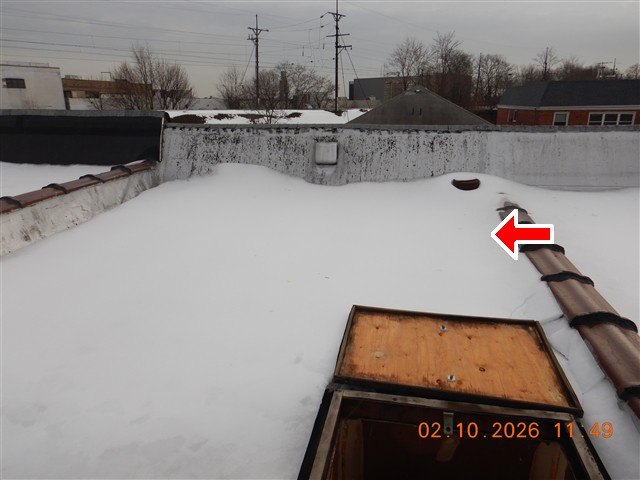
A snow-covered flat roof with an open roof hatch and parapet walls, one arrow marking the roof surface.
A flat roof buried in snow, photographed from the open roof hatch. The report notes the covering could not be inspected under ten inches of ice and snow, and the inspector returned after the thaw to finish the roof.

All three photographs are from Lou's own Astoria inspection reports, chosen because they show a building component and nothing that identifies a property or an owner.

From the Astoria files

More of what Lou has actually photographed on Astoria inspections. Open any note to learn what the finding means for a buyer — every link stays on this site.

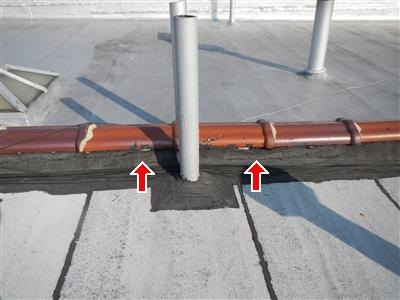
Clay coping tiles on a parapet wall with two red arrows at open mortar joints
Red arrows mark open joints beneath the clay coping tiles that cap this parapet wall. Coping is the roof wall's umbrella, and gaps in the mortar under it can let water into the masonry below.
Why this matters — the flat roof

A flat roof hides everything from the street: membrane seams, patches, drainage and parapet condition. Patching is normal maintenance — the report records what condition the membrane shows today and whether repair or further evaluation is the honest next step. How roofs are examined and reported.

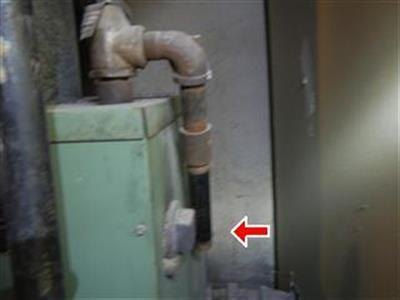
Older green boiler with a red arrow at the end of its relief-valve extension pipe.
A red arrow marks the relief-valve extension pipe on this older gas steam boiler, which ends in a threaded pipe section. The report recommends evaluation and repair by a licensed plumbing contractor.
Why this matters — the heating plant

A boiler's data plate gives its real age; the burn chamber and the piping around it give its real condition. Both go in the report so replacement budgeting is arithmetic, not argument. What an inspection costs against what it finds.

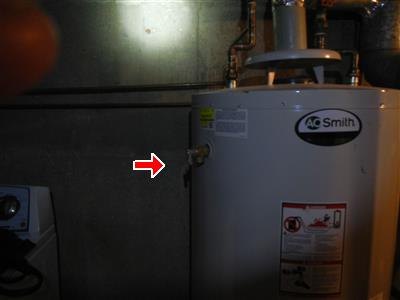
White gas water heater in a basement with a red arrow at the relief valve on its side.
A red arrow marks the temperature and pressure relief valve on the side of this gas water heater. The report notes it needs a discharge pipe extension run down to six inches off the floor, a repair for a licensed plumbing contractor.
Why this matters — the water heater

Water heaters have a known service life, and their installation — clearance, venting, the gas connection, the pan — matters as much as their age. All of it is checked where it sits. What the write-up looks like.

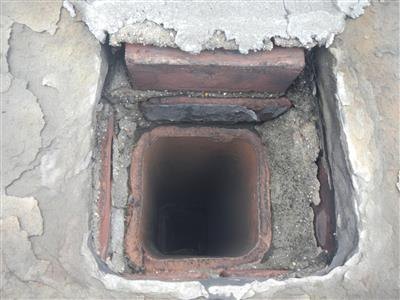
View down into a clay-lined chimney flue with cracked concrete and debris at the top
Looking straight down the chimney at the clay flue liner serving the water heater. The report finds the flue pipe six inches too short and the chimney's blue stone cap badly deteriorated, with repairs referred to a licensed mason.
Why this matters — the chimney

Chimney crowns, caps and screens are the cheap parts that protect the expensive parts. Cracked crowns and missing screens let water and animals into a flue, and the damage below can run for years unseen. What happens when part of a system cannot be seen.

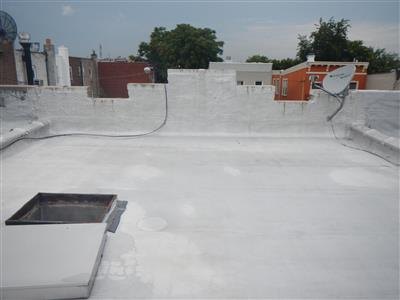
White-coated flat roof with parapet walls, a roof hatch, and a skylight curb, no vents visible.
A wide view across a flat roof with parapet walls, a roof hatch, and a skylight curb — and no roof vents anywhere. The report notes the roof is not ventilated and recommends installing vents to reduce humidity and keep the attic cool.
Why this matters — the flat roof

A flat roof hides everything from the street: membrane seams, patches, drainage and parapet condition. Patching is normal maintenance — the report records what condition the membrane shows today and whether repair or further evaluation is the honest next step. How roofs are examined and reported.

All photographs are from Lou's own inspection reports for jobs in this area, screened so nothing identifies a property or an owner.

Where this sits in Lou's territory

Lou covers Long Island, the five boroughs and Westchester from his base in Wantagh, and the archive behind these pages shows where that work has actually concentrated.

Also nearby: Flushing · Greenpoint · all 26 towns.

Call Lou Text