Under contract and on a clock? Call 516-330-3870 Text Email

Inspect This Home Inspections Army Veteran Owned · NY Licensed
Nassau County · Barrier island and canal front

Home inspections in Long Beach & Island Park: the flood zone decides what matters

In Long Beach, Island Park, Oceanside and Freeport the questions that decide whether a house is a good buy are mostly about water — where it has been, where it will go, and what was done about it.

Sandy is still the reference point

In 2012 the western bays of southern Nassau saw record coastal flooding that went above FEMA's hundred-year base flood elevation. A great many houses down here were repaired, raised, or both. The quality of that work is worth establishing.

If the house was raised

Lifting a house is major structural work and it is not always finished as carefully as it is begun.

  • How the structure sits on its new piles or columns
  • Whether utilities, panel and mechanicals went up with it
  • How the stairs, deck and entry were reconnected
  • Whether the original chimney or slab was dealt with or left

If it was repaired in place

Water leaves after a couple of weeks. What it did to the fabric of a house does not.

  • Corrosion on panels, disconnects and mechanical feet
  • Furnace, boiler or water heater still sitting at the old level
  • Replaced-looking finishes with original framing behind them
  • Persistent damp, staining or odor at the lowest level
Check the zone, not the reputation

Your address decides this, not your town

Flood zone is drawn street by street, not town by town. Long Beach, Island Park and the canal streets in Freeport are largely Zone AE. True VE — the wave-action zone — is a narrow band on the Long Beach oceanfront and out in the bay. Inland Freeport and central Oceanside are Zone X, outside the high-risk area altogether. Two houses a few streets apart can sit in different zones, so check yours on FEMA's map rather than assuming from the ZIP code.

An elevation certificate records how the building sits relative to the base flood elevation. Since FEMA moved to Risk Rating 2.0 the NFIP no longer requires one, but it can still lower a premium where FEMA's own elevation model underestimates the house. It is issued by a licensed land surveyor, engineer or architect, and your insurer sets the rate. A home inspector does neither.

What Lou can do is notice things. In an AE zone, enclosed space below the flood elevation is normally expected to have flood openings. In a VE zone that space has to be free of obstruction, or built with breakaway walls, lattice or screening — and where breakaway walls are used, the residential code expects openings in those too. Whether any of it is there is worth knowing before you own it.
Photographs from real inspections

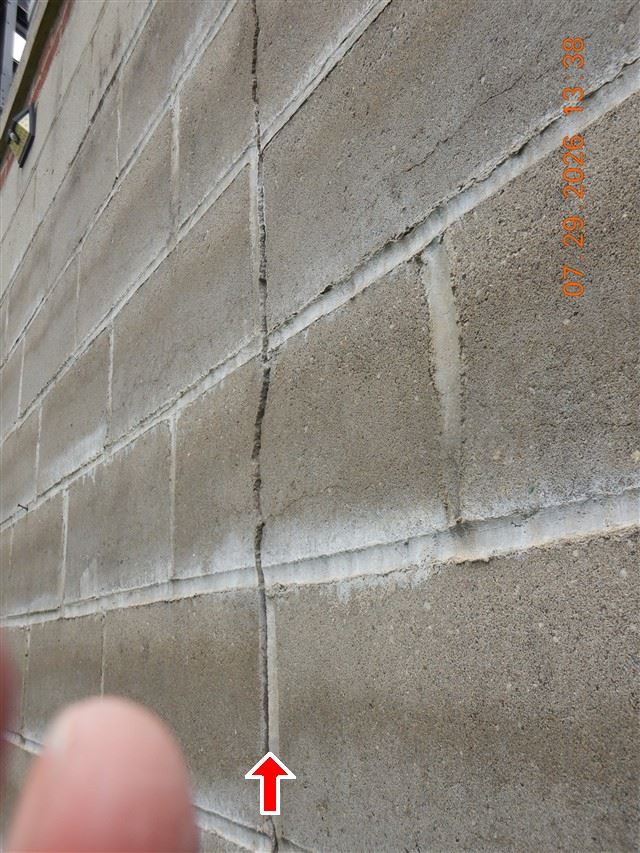
A crack in a block foundation, marked so it can be found and measured again.
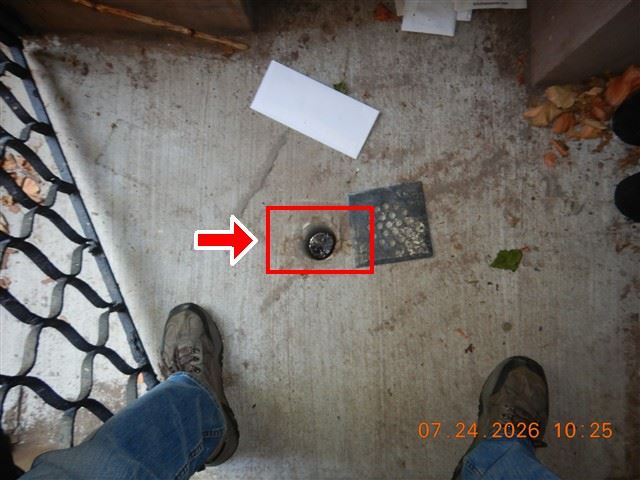
Cellar floor drain and cleanout. In a flood zone, where the water leaves matters as much as where it gets in.

Real photographs from Lou's own inspections, chosen because they show a building component and nothing that identifies a property or an owner.

Service area

Where Lou works

Long Island, the five boroughs and Westchester. The eight areas below each have their own page, because a house in Levittown and a brownstone in Brooklyn fail in completely different ways.

The real Google map, focused on Long Beach & Island Park — the area this page covers. Every area in the list below opens with its own map.

From the Long Beach & Island Park files

More of what Lou has actually photographed on Long Beach & Island Park inspections. Open any note to learn what the finding means for a buyer — every link stays on this site.

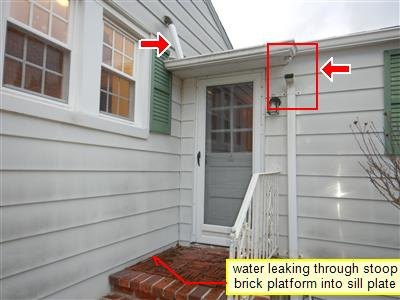
House entry with red boxes at gutter and downspout, label about water leaking through brick stoop
Red boxes mark the gutter and leader pipe at this entrance, which the report found disconnected. Roof water has been leaking through the brick stoop platform, causing extreme water damage to the sill plate in the crawl space.
Why this matters — drainage

Managing roof runoff is often one of the most cost-effective maintenance jobs a house gets — discharge against the foundation raises the risk of moisture problems below. Why drainage decides basements.

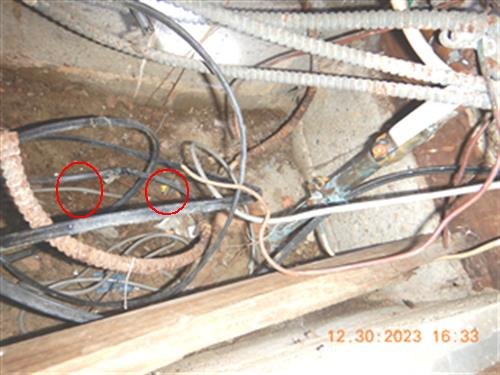
Electrical cables and pipes beneath floor framing with two points circled in red, date stamp
Electrical cables and older piping run beneath the floor framing in this crawl space, with two points among the cables circled in red.
Why this matters — older wiring

Old wiring is not automatically a defect — it is a question of condition, capacity and what was added to it over the decades. The report describes what era of wiring is present and where it needs a closer look. Old wiring and panels, explained.

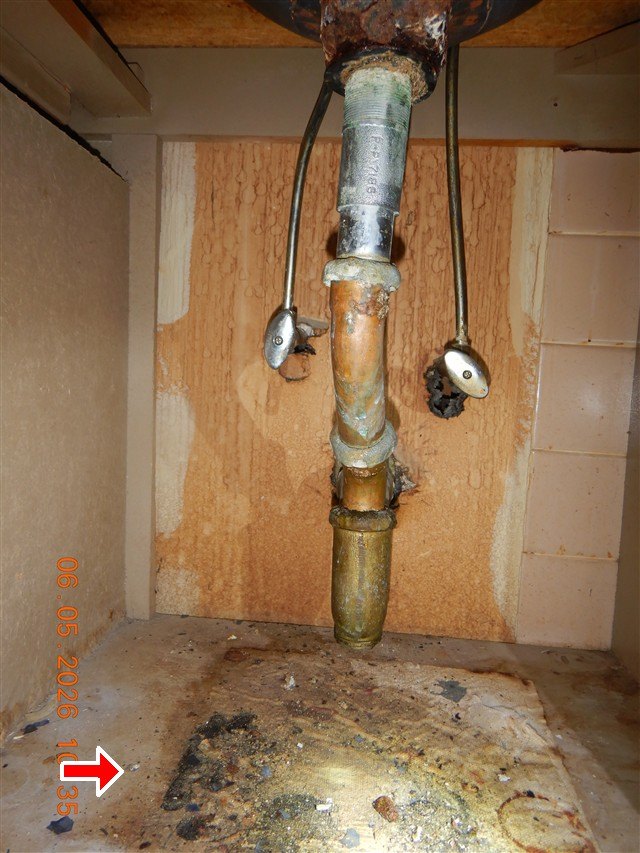
Corroded drain pipe and shut-off valves under a sink, with water staining and mold on the cabinet floor marked by a red arrow.
The arrow points to mold on the floor of this sink cabinet, beneath a corroded drain and shut-off valves; the report flags it as a safety item and recommends evaluation and repair by a licensed plumbing contractor.
Why this matters — the drains

Drains are judged where they are visible — traps, materials, slopes and improvised repairs. An improper fitting works right up until it does not, which is why it belongs in the report while it is still cheap. See how findings are written up in a real report.

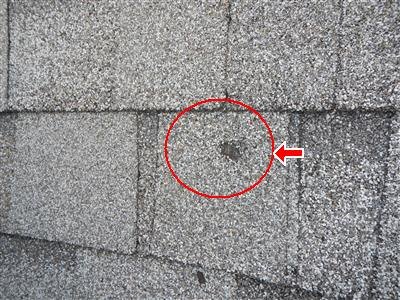
Close-up of gray asphalt shingles with a red circle and arrow around a small hole in one shingle
A red circle marks a small hole in one asphalt shingle, found on a roof slope above an air-conditioning unit. Even a small breach like this can let water past, so the report recommends having it repaired.
Why this matters — roof wear

Asphalt and slate-type roofs age in legible stages: curling, cracking, slipped pieces, exposed fasteners. Reading the stage helps establish the visible wear and whether maintenance, repair or further evaluation is the honest next step. The report must say how the roof was examined.

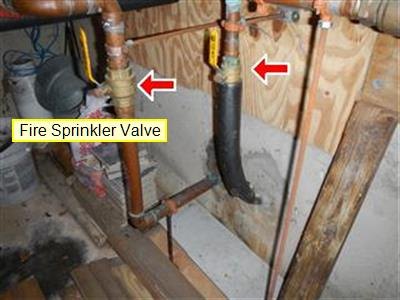
Copper piping with two red arrows at valves and a yellow label reading Fire Sprinkler Valve
Arrows mark the valves on this copper piping, with the fire sprinkler valve labelled. Part of an inspection is simply identifying and recording where the shutoffs and sprinkler valves are, so the owner knows what controls what.
Why this matters — supply plumbing

Supply plumbing is judged by material and era — and by the small evidence at the joints. Corrosion and mineral tracks at connections show slow weeping long before a failure. Moisture evidence, explained.

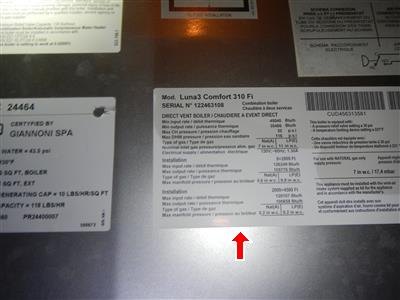
Manufacturer data plate on a boiler listing model, serial number, and input ratings, red arrow
The manufacturer's data plate on a combination boiler, listing the model, serial number, fuel type, and input ratings. Inspectors photograph these plates because they establish the unit's age, capacity, and whether it matches the fuel it is connected to.
Why this matters — the heating plant

A boiler's data plate gives its real age; the burn chamber and the piping around it give its real condition. Both go in the report so replacement budgeting is arithmetic, not argument. What an inspection costs against what it finds.

All photographs are from Lou's own inspection reports for jobs in this area, screened so nothing identifies a property or an owner.

Call Lou Text