Under contract and on a clock? Call 516-330-3870 Text Email

Inspect This Home Inspections Army Veteran Owned · NY Licensed
Suffolk County · Long Island

Home inspection in Suffolk County, NY

Between 2014 and 2025, Lou Rubino inspected more than 130 homes in Suffolk County — from West Islip and Lindenhurst on the South Shore to Huntington, Dix Hills and Smithtown, and out east as far as Wading River, Hampton Bays and Amagansett. Cross the county line from Nassau and one thing changes that a Nassau buyer never had to think about: most houses here handle their own water and their own waste.

Rated 4.9 on Google as of November 2026 · U.S. Army veteran owned · NY licence #16000039568 · 516-330-3870

In Suffolk, the water and the waste are yours

Roughly three-quarters of Suffolk County is not sewered — on the order of 360,000 homes rely on a cesspool or a septic system in the yard. A cesspool and a septic system are not the same thing; they fail differently, and replacing one is a five-figure job rather than a repair. Establish which one is there, roughly how old it is, where it sits, and whether anything has been built over it.

Further out, the drinking water is yours too. On a private well you are your own water utility: no one is testing it for you, and nothing will tell you when it changes. New York's standards do not require an inspector to evaluate wells, pumps, pressure tanks or septic systems at all. Lou will note what is visible, tell you how it presents on the day, and the report will say plainly where his scope ended. He does not take a fee for sending you to a specialist — New York forbids referral fees in connection with an inspection.

The houses themselves run the full range. West Islip and Lindenhurst filled in through the 1950s and 60s with capes, ranches and splits that age the way sixty-year-old South Shore houses do — eaves and soffits first where gutters failed quietly, boilers from the fittings inward. Dix Hills and Melville carry 1960s–80s colonials on lots that dwarf the quarter-acre South Shore: more roof planes, more framing spans, more systems, and more room for fifty years of ownership to leave marks.

Related: Septic and well, explained · West Islip, town by town · Dix Hills and the big lots.
What the inspection can examine here

  • Cesspool or septic — which one, how old, where it sits, and what can honestly be established during a standard inspection.
  • Well, pump and pressure tank where there is no public water — noted as found; the evaluation itself is a specialist job with its own laboratory.
  • Eaves, soffits, boilers and additions on the 1950s–60s South Shore stock; roof planes and panels on the big North Shore colonials.
  • Radon — 7.6% of tested Suffolk basements were at or above the action level, and three in the sample came in above 20. A separate test.

County-wide facts every Suffolk County buyer shares

These are the same for every town in Suffolk County, so each town page links here instead of repeating them. Each one cites its source.

The building code in Suffolk County

Suffolk County homes fall under the New York State Uniform Fire Prevention and Building Code (19 NYCRR), which applies everywhere in the State except New York City and is enforced locally by each town and village. Source: dos.ny.gov.

Water and sewer in Suffolk County

The Suffolk County Water Authority, a public-benefit corporation, serves approximately 1.2 million Suffolk residents, drawing all of its water from the Long Island sole-source aquifer; the rest of the county is on smaller water districts or private wells. Much of Suffolk relies on on-site cesspools and septic systems, which the county identifies as the main source of nitrogen pollution. The Suffolk County Department of Health Services Office of Wastewater Management regulates them under the Suffolk County Sanitary Code (Article 6 for design/lot-size/sewage-disposal requirements; Article 19 and the I/A OWTS standards for innovative/alternative systems), reviews permits and inspects installations, which must be done by a licensed liquid-waste installer. The inspection reports what the house actually has and its visible condition; a cesspool or septic system needs its own evaluation. Source: open.nysenate.gov.

Flood zones in Suffolk County

Flood zones follow the address, not the town. OpenFEMA holds 33,936 NFIP claim records for Suffolk County (FIPS 36103). The county's 2020 Hazard Mitigation Plan notes Suffolk has more NFIP claims than policies because repetitive-loss properties file repeatedly; the Town of Islip alone had 564 repetitive-loss properties, 5,445 policies and 5,419 claims. Look the address up on FEMA’s Flood Map Service Center before you sign. Source: www.fema.gov.

Radon in Suffolk County

Suffolk County is in EPA Zone 3 (low potential) — Zone 3 counties have a predicted average indoor radon screening level below 2 pCi/L; EPA still recommends testing every home. NYSDOH's county estimate (Feb 2007, 358 homes measured) is 0.5% of living areas and 6% of basements above 4 pCi/L, with Huntington (11%) and Smithtown (9%) basements the highest. Radon is a separate, optional test arranged alongside the inspection. Source: www.epa.gov.

Is there a local rule in Suffolk County a buyer should know about?

A 2017 amendment to Article 6 of the Suffolk County Sanitary Code eliminated in-kind cesspool replacements: a failed cesspool cannot simply be replaced with another cesspool; replacement septic and cesspool work goes through the Health Department (SHIP application) and must be inspected before use. Source: suffolkcountyny.gov.

Anything else specific to Suffolk County?

Suffolk County adopted revised Standards for the management and approval of Innovative/Alternative Onsite Wastewater Treatment Systems (I/A OWTS) under Article 19 of the Sanitary Code, defining how I/A systems must be designed and built as the county transitions away from conventional cesspools and septic systems. Source: www.suffolkcountyny.gov.

Suffolk County, town by town

Every Suffolk County town and neighbourhood in Lou's own records, each with the real count and its years — one house or twenty. The photographs on each page come from his reports on homes in that town.

Photographs from Suffolk County reports

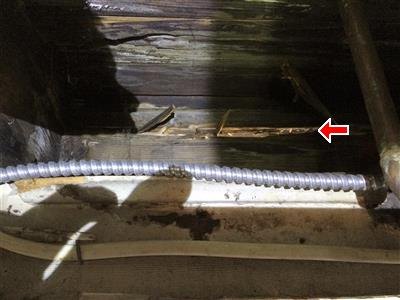
Water-damaged wood rim joist beneath a steel basement entrance door, marked by a red arrow, with an armored cable running across.
A red arrow marks water damage to the wood rim joist at the basement entrance, beneath the steel Bilco door. The report notes the door itself is badly rusted and recommends evaluation and repair by a licensed exterior door contractor.
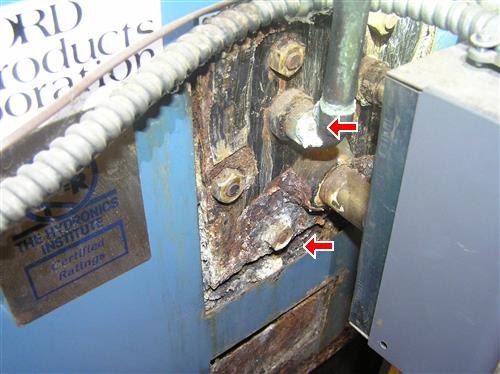
Heavily corroded pipe fittings on the side of a boiler, two points arrowed.
Arrows mark heavy corrosion at the boiler face plate, where the report finds the hot water coil corroded and leaking and the copper fittings corroded. It recommends evaluation and repair by a licensed plumbing contractor.
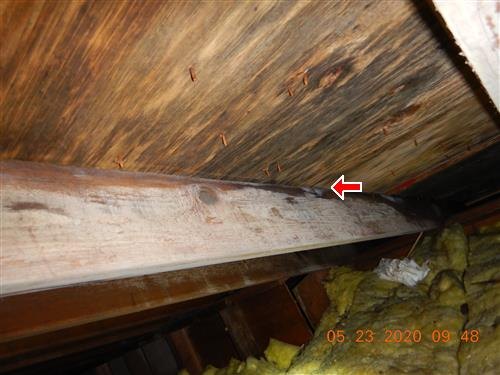
Attic roof sheathing meeting a wood framing member, with dark discoloration and a red arrow at the junction.
The arrow marks where the roof plywood has lifted off the framing in this attic — the report notes it is raised in several bays and is pushing up the shingles above. A roof contractor is recommended to evaluate and refasten it.

All three photographs are from Lou's own Suffolk County inspection reports, chosen because they show a building component and nothing that identifies a property or an owner.

Where this sits in Lou's territory

Wantagh sits a few miles west of the county line, so western and central Suffolk are a routine drive; the East End is a scheduled trip and quoted as one. The archive shows the work concentrating along the South Shore and the Huntington–Dix Hills corridor, with jobs out to the Hamptons and the North Fork.

Also: Nassau County · Huntington & Northport · What an inspection costs · all 250 towns.

Call Lou Text