Under contract and on a clock? Call 516-330-3870 Text Email

Inspect This Home Inspections Army Veteran Owned · NY Licensed
Brooklyn · Lefferts Manor

Home inspector in Prospect Lefferts Gardens, NY

Between 2016 and 2025, Lou Rubino inspected 8 homes in Prospect Lefferts Gardens. The heart of the neighbourhood is Lefferts Manor, where an 1890s covenant kept the rowhouses single-family — so unlike most of brownstone Brooklyn, these houses were never carved into units and re-assembled. What you buy is closer to the original building, with the original building's systems.

Rated 5.0 on Google as of August 2026 · U.S. Army veteran owned · NY licence #16000039568 · 516-330-3870

Closer to original means older systems

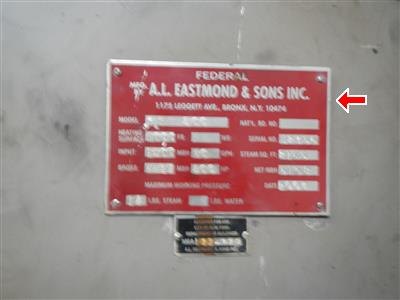
Never being cut into apartments spared these houses a lot of rough alteration — and left more first-generation fabric in service. Steam heat is the emblem: Lou still finds steam boilers at work on these jobs, and a steam system is its own inspection discipline — the boiler's condition, the plate that dates it, and what a replacement actually involves.

The limestone and brick fronts, over a century old, move slowly and show it — cracks at piers and around ornament that need tracing, not summarising, because the difference between finished movement and active movement is the difference between character and a masonry contract.

Related: How Lou inspects a brownstone · What an inspection costs · Schedule an inspection.
What the inspection can examine here

  • Steam systems, as steam systems — the boiler, its age, and what replacement actually involves.
  • Limestone and brick fronts — movement traced, not summarised.
  • First-generation fabric — houses never cut into units keep more original systems in service.
  • The full rowhouse scope — how Lou inspects a century-old row house.

Photographs from Prospect Lefferts Gardens reports

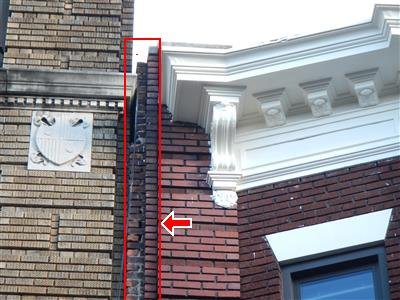
An ornamented brick facade with a red box and arrow marking a corner where the bricks are deteriorated and the mortar joints have eroded
The red box and arrow mark the upper corner of a brick facade where the bricks are deteriorated and the mortar joints have eroded. The report calls for repointing by a licensed brick pointing contractor and flags this section as a priority.
A red manufacturer's plate on a steel steam boiler, reading A.L. Eastmond and Sons Inc.
The manufacturer's ID plate on a steam boiler; the model and serial numbers on the plate are how a boiler is identified and dated. The report notes this is a commercial dual-fuel boiler that runs mostly on natural gas and was last overhauled in 2004.
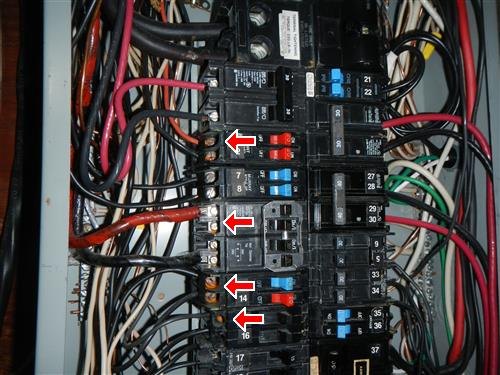
An open electrical panel with red and black wiring and four red arrows marking water-damaged breakers on the left side
Four red arrows mark breakers on the left side of this main panel that show water damage. Water getting into a panel corrodes breakers and their connections, and the report calls for evaluation and repair by a licensed electrical contractor.

All three photographs are from Lou's own Prospect Lefferts Gardens inspection reports, chosen because they show a building component and nothing that identifies a property or an owner.

From the Prospect Lefferts Gardens files

More of what Lou has actually photographed on Prospect Lefferts Gardens inspections. Open any note to learn what the finding means for a buyer — every link stays on this site.

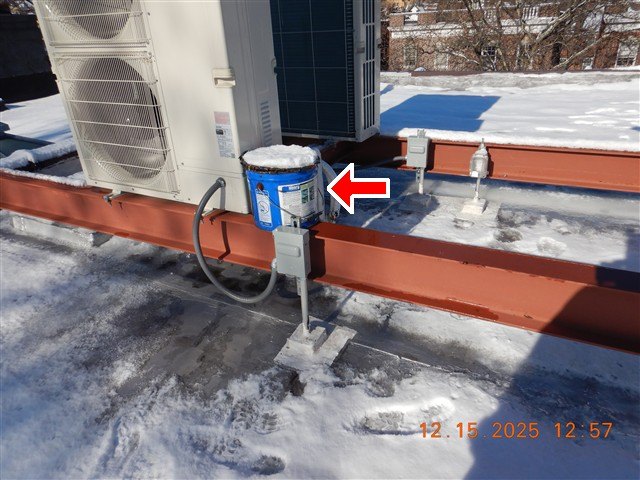
Snow-covered flat roof with two condenser units on steel rails and a red arrow at an old roofing-cement can left on the roof
A snow-covered flat roof with air-conditioning condensers on steel rails; the arrow marks an old roofing-cement can left on the roof. The report flags this as a safety item because a loose can on a roof can become a missile in a wind storm.
Why this matters — why findings are photographed

Every photograph in a report exists to make a finding checkable — the point is not the picture, it is that you and your attorney can see exactly what the inspector saw. Read a complete sample report.

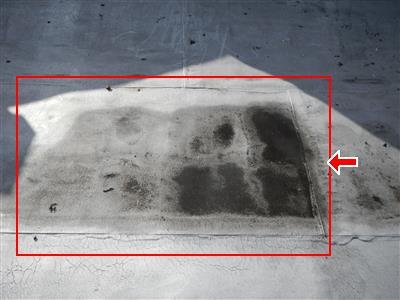
Flat roof membrane with a dark stained rectangular area outlined in red with an arrow
The red box outlines a dark stained area where water has been puddling on this flat rubber roof. Standing water ages a membrane faster, and the report recommends evaluation and repair by a licensed roofing contractor.
Why this matters — the flat roof

A flat roof hides everything from the street: membrane seams, patches, drainage and parapet condition. Patching is normal maintenance — the report records what condition the membrane shows today and whether repair or further evaluation is the honest next step. How roofs are examined and reported.

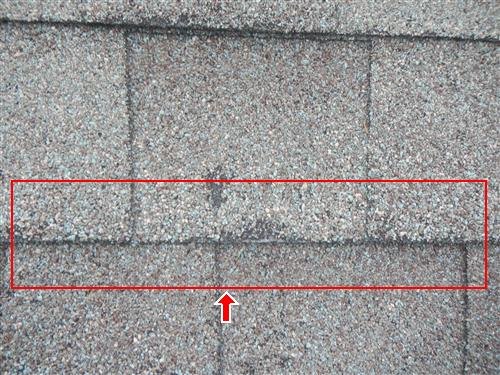
Close-up of asphalt shingles with a red box and arrow marking a band where the fiberglass backing is exposed at the shingle edges
The red box marks a course of shingles where the protective granules have worn away and the fiberglass backing is being exposed at the shingle edges. Exposed backing means the shingles are near the end of their service life; the report recommends evaluation and repair by a licensed roofing contractor.
Why this matters — roof wear

Asphalt and slate-type roofs age in legible stages: curling, cracking, slipped pieces, exposed fasteners. Reading the stage helps establish the visible wear and whether maintenance, repair or further evaluation is the honest next step. The report must say how the roof was examined.

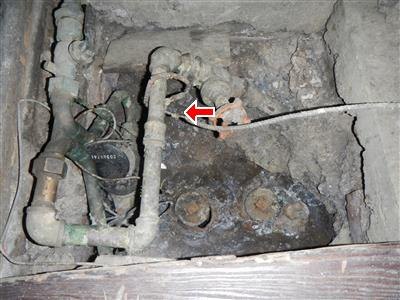
Corroded water piping and valves in a dirt-floored access pit, with a red arrow at the broken ground wire clamp on the water main
The home's water main sits in a below-floor pit; the arrow marks where the electrical system's ground wire clamp is broken at the main. That clamp is part of the path that carries an electrical fault safely to earth, so the report recommends repair by a licensed electrical contractor.
Why this matters — supply plumbing

Supply plumbing is judged by material and era — and by the small evidence at the joints. Corrosion and mineral tracks at connections show slow weeping long before a failure. Moisture evidence, explained.

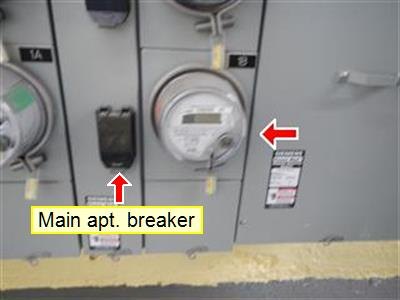
Electric meter bank with red arrows and a yellow label reading Main apt. breaker
In a multi-family building each apartment has its own meter and main breaker at a shared bank like this; the label marks which breaker shuts off the apartment. Knowing where the main disconnect is matters in an emergency.
Why this matters — the electrical panel

An inspector removes the readily accessible panel covers because New York requires it — most of what matters in a panel is invisible with the cover on. Double-tapped breakers, mixed wire eras and scorched connections are all findings that only appear with the cover off. Why the covers come off.

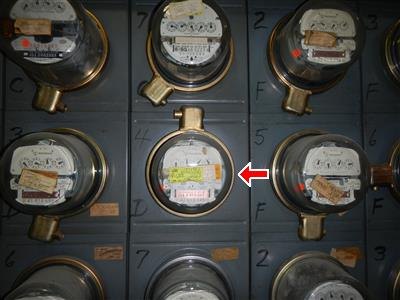
Grid of round glass electric meters with a red arrow marking one meter
A wall of electric meters in a multi-family building; the arrow identifies the meter serving the unit being inspected. Matching the right meter and disconnect to the apartment is a standard inspection step.
Why this matters — the electrical panel

An inspector removes the readily accessible panel covers because New York requires it — most of what matters in a panel is invisible with the cover on. Double-tapped breakers, mixed wire eras and scorched connections are all findings that only appear with the cover off. Why the covers come off.

All photographs are from Lou's own inspection reports for jobs in this area, screened so nothing identifies a property or an owner.

Where this sits in Lou's territory

Lou covers Long Island, the five boroughs and Westchester from his base in Wantagh, and the archive behind these pages shows where that work has actually concentrated.

Also nearby: Crown Heights · Park Slope · all 26 towns.

Call Lou Text