Under contract and on a clock? Call 516-330-3870 Text Email

Inspect This Home Inspections Army Veteran Owned · NY Licensed
Westchester · colonial

Home inspector in Chappaqua, NY

In 2015, Lou Rubino inspected one home in Chappaqua — one job, one written report, and the photographs below come from it. The report describes a colonial, about 39 years old.

Rated 4.9 on Google as of November 2026 · U.S. Army veteran owned · NY licence #16000039568 · 516-330-3870

What the Chappaqua report found

The report, as Lou wrote it up.

2015, a colonial, about 39 years old, a townhouse: 14 items flagged: 6 roof, chimney and attic; 4 structure; 3 exterior. As recorded: gable roof, 3-tab fiberglass, seen from: ladder, framed with 2 x 10 rafters; attic: pull down stairs and storage, r-19 or better insulation, gable vents, soffit vents and thermostatically controlled fan ventilation; t-111 wood siding, chimney: wood; poured concrete foundation, slab floor framing, supporting walls; insulated ducts, 80 gallon (plenty) electric water heater (utility room); 150-amp circuit breakers (Murray), romex wiring, copper supply pipes, public water, air conditioner unit; casement and double-hung windows, hardwood t&g and carpet floors, laminate cabinets, granite counters. Flagged, in Lou’s words: “Rear roof shingles missing”; “Currently two layers of roofing on structure”; “Skylights have many spider cracks”; “Gutters are filling with leaf debris”; “Rear leader pipe over garage extension should be extended to meet lower gutter. This will extend life of roofing on lower section”; “Rear leader pipe at rear of garage should be extended away from foundation”; “Front leader pipe near entrance needs to be extended away from entrance”; “Siding seam opening up over rear bedroom sliding door”; “Siding deteriorated over rear living room window”; “Stucco peeling away from rear garage foundation”; “Caution Safety Item: Rear balcony railing and platform nails are pulling out of structure”; “Patio needs a retaining wall around perimeter to prevent future erosion and wash-outs”; “Foundation cracked on left side toward rear of garage”; “Floor settled in utility room behind garage”. Also noted: “Did not see exterior outlets”; “Rear balcony railing and platform nails are pulling out of structure”; “Shower valve handle set screw is loose”; “Aluminum wire conductors for A/C unit”; “Main panel in wood access cabinet in front to right of garage”; “Remote damper affords positive closure of flue, very good”; “Leaking refrigerant at filler connection to condenser unit”. On the day: 80°F, clear, damp ground, rain in the three days before; the house faces north. Not inspected that day: insulation under floor system; outlets & fixtures; vapor retarders. Not present in this house: basement windows; burner; combustion air; fuel storage and distribution systems; gas meter; gas/lp firelogs and fireplaces; main fuel shut off; sump pump; trash compactor; windows.

“Flagged” is HomeGauge’s Repair or Replace mark, not a verdict on the house. See a complete report.

Related: The Westchester page · What an inspection costs · Schedule an inspection.

What the inspection can examine here

Photographs from Chappaqua reports

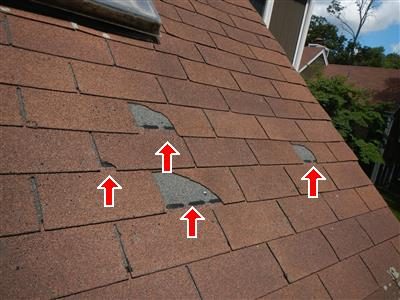
Asphalt shingle roof with several missing shingle pieces marked by four red arrows.
Rear roof shingles are missing on this Chappaqua townhome, with the gaps marked in the roofing section of the report.
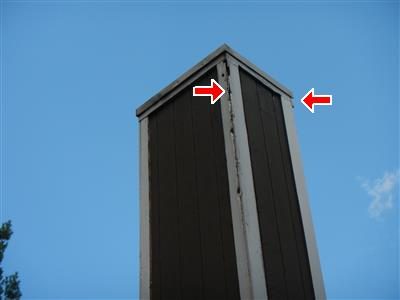
Wood-sided chimney chase against a blue sky with two red arrows at the corner trim near the top.
Chimney corner moulding is dry rotted on the sides, marked by the two arrows. The report's next picture records the same moulding dry rotted at the bottom.
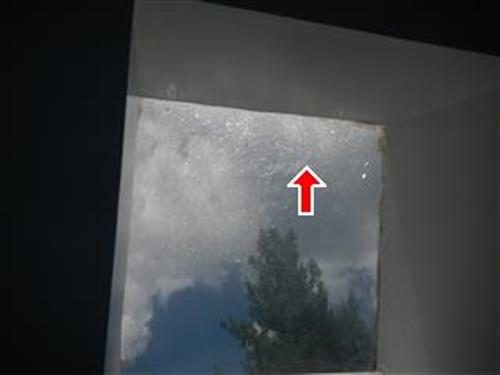
Skylight seen from inside, its glazing covered in small cracks, with a red arrow pointing at them.
Skylights have many spider cracks. The same page notes gutters filling with leaf debris; Lou recommended cleaning and installing gutter guard to help prevent ice damming.

All three photographs are from Lou's own Chappaqua inspection reports, chosen because they show a building component and nothing that identifies a property or an owner.

Buying in Chappaqua: the questions with sourced answers

Each answer is built from Chappaqua’s own rows in public data — the Census, NYSDOH, NYSDEC, FEMA, the office that holds the permits — or from Lou’s reports, and cites its source. Data retrieved 1 November 2026.

How old are the houses in Chappaqua?

Median year built in zip 10514: 1965 (Westchester: 1958). Of 4,205 units, 24% predates 1940; 9% is from 2000 on. Next come the 1960s at 15% and the 1980s at 15%. An older house is not a worse house, but its wiring, plumbing and roof were installed under different rules and replaced piecemeal, which is what the inspection looks for. Lou’s reports here: 39 years old. (ACS)

How are homes in Chappaqua heated? Is an oil tank likely?

48% fuel oil or kerosene, 37% utility gas; fuel oil 48% against 30% county-wide. NYSDEC logs 973 petroleum spills at private homes in Chappaqua since 1986, 225 since 2015. 32 were logged in 2012, the year of Hurricane Sandy. Ask about a tank, and for closure papers. A tank can be buried in the yard or sit in the basement, and a removed one should come with paperwork. Buried tanks are outside the standards New York sets for a home inspection, so the seller’s answer matters. (ACS, NYSDEC)

Is Chappaqua mostly houses or apartments, owned or rented?

84% detached houses, 6% attached single-family houses, 4% buildings of 5 to 9 units; 88% owner-occupied (Westchester: 62%). Detached houses dominate, so most inspections here run from the roof to the foundation of one building. Lou’s jobs here included a townhouse. (ACS)

Is radon a concern in Chappaqua?

Town of New Castle: 149 basement tests, average 2.27 pCi/L, 18 at 4 or above (12%). Westchester: 18% of 2,826. First-floor tests there: 33, average 1.1. On the share at 4 or above, it ranks 19th of the county’s 23 towns and cities. The highest basement reading was 31.7 pCi/L. EPA’s action level is 4 pCi/L, and it advises testing every home whatever the area’s results. Radon testing is optional. (NYSDOH)

Has Chappaqua flooded? Is the house in a flood zone?

144 flood-insurance claims from zip 10514 since 1978, most in 1980 (31): 63rd of the 189 zips on these pages. A claim count describes the zip, not the house. Flood zones follow the address. Check the address on FEMA’s map. (OpenFEMA)

Who holds the permits and certificate of occupancy in Chappaqua?

The Town of New Castle Building Division (Development Department). Chappaqua is an unincorporated hamlet of New Castle. Your attorney usually runs the search. The inspection reports the condition of what is there and flags work that typically needs a permit, such as a finished basement, a dormer or a moved panel, so you know what to ask about.

How does Chappaqua compare with the towns around it?

By median year built, fuel-oil share and owner-occupancy: Chappaqua (zip 10514) 1965, 48%, 88%; Pleasantville (zip 10570): built 1960, oil 41%, 86% owner-occupied; Ossining (zip 10562): built 1962, oil 33%, 61% owner-occupied; Briarcliff Manor (zip 10510): built 1970, oil 25%, 82% owner-occupied. (ACS)

Which code, water and sewer rules apply in Chappaqua?

The New York State Uniform Code, the local water suppliers and the county rule on testing private wells at sale: county-wide, written once. They are the same for every town in Westchester, so they are set out there with their sources instead of on each page.

How much does a home inspection in Chappaqua cost, and how fast is the report?

Lou quotes the actual property, not a flat rate — what drives the price is size, age and what is included. The written report arrives the same day as a rule; a large or complex house can run to the next morning. Call or text 516-330-3870.
Where this sits in Lou's territory

Lou covers Long Island, the five boroughs and Westchester from his base in Wantagh, and the archive behind these pages shows where that work has actually concentrated.

Nearby towns Lou has inspected: Pleasantville · Ossining · Briarcliff Manor · Croton-on-Hudson · Congers · White Plains · all 250 towns.

Call Lou Text